“Mard ko dard nahi hota” and other lies we grew up on
Every Indian boy hears them. “Ladke rote nahi.” “Kamaane wala hi mard hai.” “Help maangna kamzori hai.” They sound harmless, even funny. But these lines quietly shape how men love, work, parent and suffer. Here are 8 lies we grew up on, the truth behind each one, and how to stop passing them on.

Jai V. Pareek
Soft skills & EQ coach
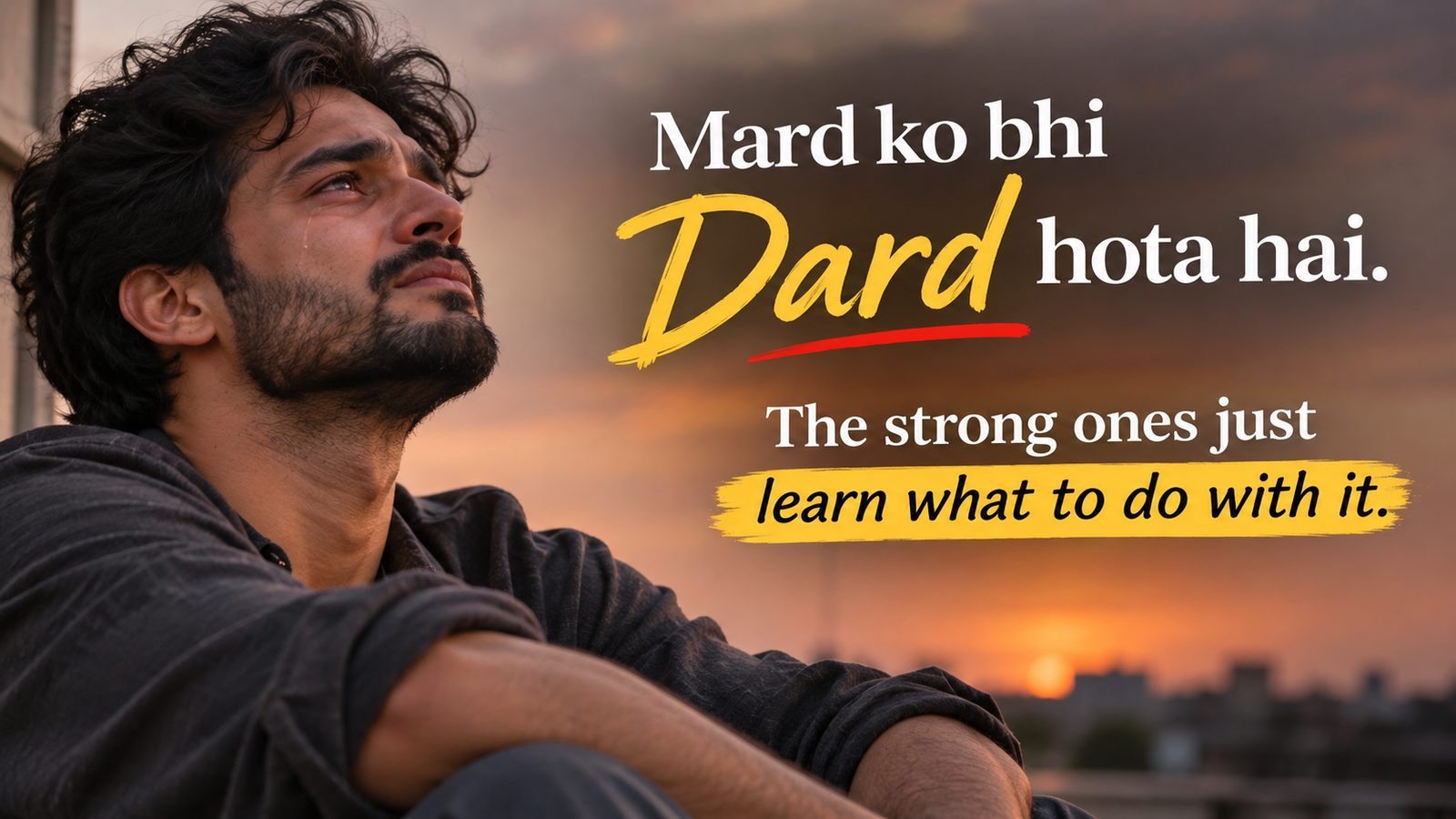
Mard ko bhi dard hota hai. The strong ones just learn what to do with it.
In this post
Short on time? Remember these 3 things
- The lines boys hear growing up become the rules men live by, often without ever questioning them.
- These lies don’t make men stronger. They make men lonely, angry and disconnected from the people they love.
- You can rewrite the script: notice the lie, question it, replace it, and model the new version for the next generation.
An eight-year-old falls off his cycle in the colony. His knee is bleeding, his palms are scraped, and his eyes fill up. Before he can even cry, an uncle walking past laughs and says, “Arre, uth ja! Mard ko dard nahi hota.” Everyone around chuckles. The boy wipes his eyes, stands up and limps home. He doesn’t cry. He has just learnt something that will stay with him for the next forty years.
That uncle didn’t mean any harm. He probably heard the same line from his own father. That’s how these lies survive: not through bad people, but through loving people repeating what they were taught.
This post is not anti-men, and it’s not about blaming our parents. It’s about looking honestly at the sentences that built us, keeping what’s useful, and dropping what’s quietly hurting us. Let’s go through them one by one.
“Mard ko dard nahi hota”
The most famous one, made even more famous by films. It teaches boys that pain, physical or emotional, is something to deny. So men ignore chest pain until it’s serious, skip doctor visits, push through injuries and bury grief.
But pain doesn’t disappear when you deny it. It moves. Into your temper, your sleep, your body, your relationships. The man who “feels no pain” is usually the man carrying the most of it.
Lie
A real man doesn’t feel pain.
Truth
Every man feels pain. A strong man admits it, takes care of it, and doesn’t let it turn into poison.
“Ladke rote nahi”
Tears are the body’s natural way of releasing overwhelming emotion. Little boys cry exactly as much as little girls. Somewhere between age 5 and 12, boys are trained out of it. “Ladkiyon ki tarah kyun ro raha hai?”
So grown men stop crying at funerals, at goodbyes, at their child’s birth. Not because they don’t feel it, but because they’ve been taught the feeling is shameful. Many men tell me the first time they cried as adults was alone, in a car or a bathroom, so nobody would see.
Lie
Crying is for girls.
Truth
Crying is for humans. Tears are not weakness leaving the body, they are stress leaving the body.
“Kamaane wala hi asli mard hai”
Providing for your family is a beautiful responsibility. But when a man’s entire worth is measured by his salary, something breaks. A layoff becomes a loss of identity. A wife earning more becomes a threat instead of a blessing. A father becomes an ATM that comes home late and leaves early.
Ask any grown child what they remember about their father. It’s almost never the salary. It’s whether he showed up, listened, laughed, and was present.
Lie
A man is worth what he earns.
Truth
Money is one thing a man provides. Presence, safety, love and character are the things his family remembers.
“Help maangna kamzori hai”
It starts small: not asking for directions, not asking the teacher a doubt. Then it grows: not asking a senior for guidance, not asking a friend for a loan before it’s too late, not seeing a doctor or a counsellor.
The irony? Every successful man you admire had mentors, coaches and advisors. Asking for help is not the opposite of strength. It is how strong people get stronger.
Lie
A real man solves everything alone.
Truth
A smart man knows when to ask, whom to ask, and doesn’t waste years being proud and stuck.
“The lies we were told as boys don’t stay in childhood. They show up in our marriages, our offices and our parenting.”
“Ghar ka kaam auraton ka kaam hai”
Boys watch their mothers cook, clean, manage the house and the kids, while fathers watch TV. Boys who try to help hear “tu rehne de, tu ladka hai”. Then they grow up, get married, and are surprised that their wives are exhausted and resentful.
Cooking, cleaning and caring for your children are not “helping your wife”. They are running your own home. And the man who mocks another man as “joru ka ghulam” for doing dishes is usually the man whose own home is quietly unhappy.
Lie
Housework is beneath a man.
Truth
A man who shares the load at home earns a partner, not just a caretaker. That is real respect.
“Mard ko sab pata hona chahiye”
The man of the house must always have the answer: the car problem, the money decision, the career advice, the route. So men pretend. They bluff in meetings, make big financial decisions without asking, and argue instead of saying three simple words: “I don’t know.”
Saying “I don’t know, let me find out” is not losing face. It’s the beginning of learning. The men who need to look like they know everything are usually the ones who learn the least.
Lie
A man must always be in control and have the answers.
Truth
Confidence is not knowing everything. It is being comfortable saying “I don’t know yet”.
“Baap ka dar hona chahiye”
Many of us grew up in homes where the father’s footsteps meant silence. Kids went quiet when Papa came home. Fear was confused with respect.
Fear does create obedience, while the father is watching. But it also creates distance. Children of strict, scary fathers often stop sharing their problems, hide their mistakes, and grow into adults who still can’t have a real conversation with their dad. Respect that comes from fear lasts until the child is strong enough. Respect that comes from trust lasts a lifetime.
Lie
A good father is a feared father.
Truth
A good father is a safe father: firm when needed, but someone his children run towards, not away from.
“Apni problem khud solve kar, kisi ko mat bata”
Men have friends for cricket, trips, drinks and memes. But very few have a friend they can call and say, “Bhai, I’m not okay.” We were taught that sharing problems is complaining, and complaining is weak.
So men carry business losses, marriage troubles, debt, health scares and loneliness alone, smiling in every group photo. Isolation is not independence. Every man needs at least one person he can be completely honest with.
Lie
Men should keep their problems to themselves.
Truth
A problem shared with the right person becomes lighter, clearer and easier to solve.
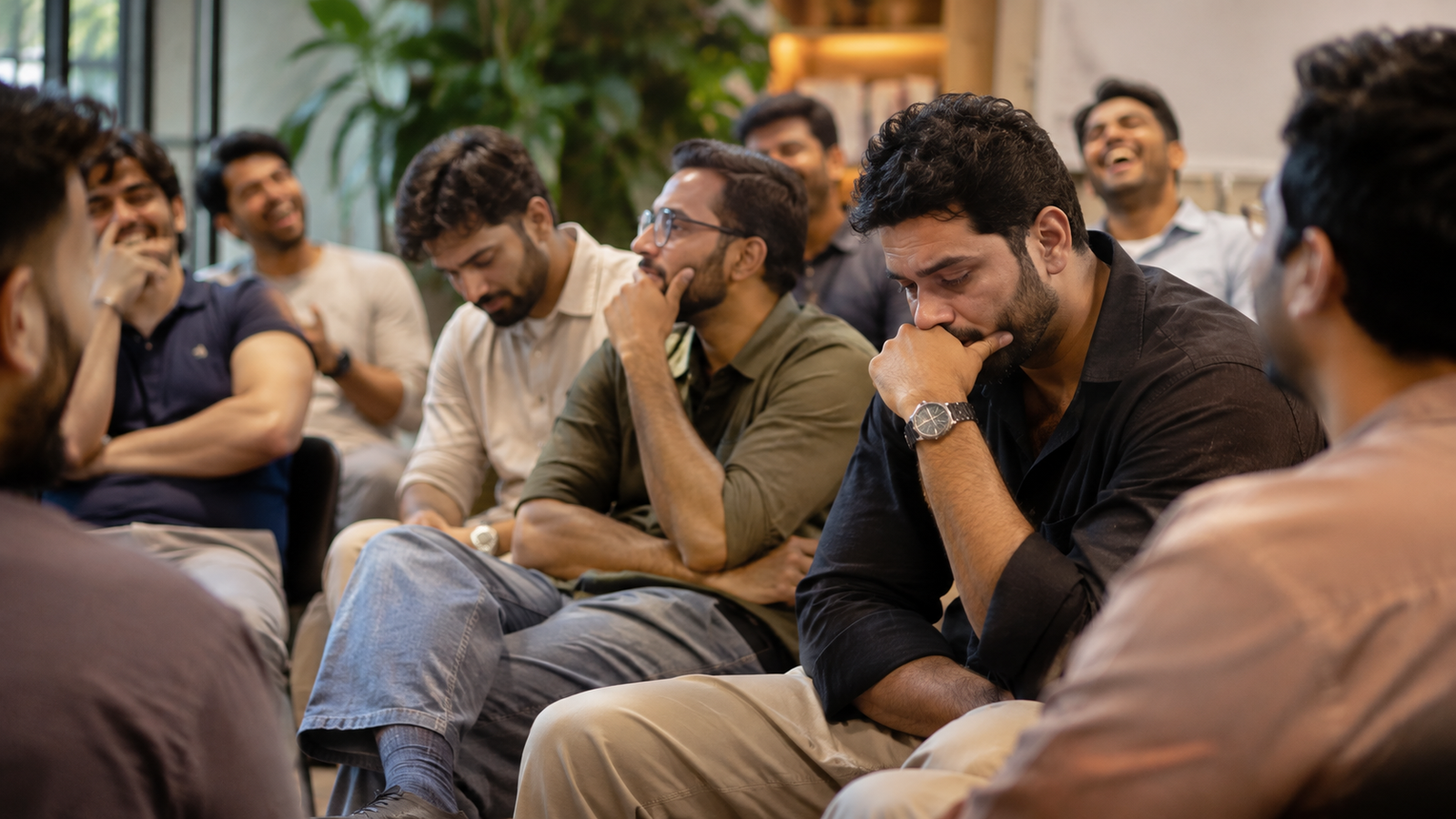
What these lies cost us
Put all eight together, and you get a very familiar man. He works hard, provides well, and is respected outside. But at home he is either angry or absent. He has many contacts but few real friends. His wife feels lonely next to him. His kids know his rules but not his heart. And he himself is tired in a way sleep doesn’t fix.
None of this is because he’s a bad man. It’s because he’s been following a rulebook that was never designed for happiness. It was designed for survival, in a very different time. The good news: rulebooks can be rewritten.
How to rewrite the script
You don’t have to throw away everything you were taught. Responsibility, hard work, protecting your family, those are worth keeping. You just need to filter out the lies. Here’s how:
Notice the lie
Catch the voice in your head. When you hold back tears, refuse help or snap at your kid to “be a man”, ask: “Whose voice is this? Where did I learn this?” Awareness is the first crack in the old script.
Question it
Ask honestly: “Is this rule actually making my life better? Is it making my relationships better?” If the answer is no, it’s not a value. It’s a habit you inherited.
Replace it
Write your new rule in one line. “Mard ko dard nahi hota” becomes “I feel pain, and I deal with it.” “Help maangna kamzori hai” becomes “Smart men ask early.” Say it to yourself until it feels normal.
Model it
Live the new rule where others can see it: your son, your nephew, your younger team members. One man changing his behaviour quietly gives permission to every boy watching him.
What to say instead
The fastest way to break a lie is to replace it with better words, out loud. Here are a few you can start using today.
When your son falls and cries
Instead of “mard ko dard nahi hota”, acknowledge the pain, then build courage.
“That really hurt, na? It’s okay to cry. Let’s clean it up. You’re brave, and brave people can cry too. Ready to try the cycle again?”
When a friend says “sab badhiya hai” but clearly isn’t okay
Men rarely open up on the first ask. Make it safe to say more.
“Bhai, you’ve seemed off for a few weeks. No pressure, but I’m here. Chal, chai pe chalte hain. Just us.”
When a relative mocks you for helping at home
No need to argue. A light, confident line says enough.
“Chacha, it’s my house too. If I eat here, I can clean here. Aap bhi try karo, chachi khush ho jayengi!”
To yourself, on a hard day
The most important conversation is the one inside your own head.
“Today was heavy, and that’s okay. I don’t have to carry everything alone. I can feel this, talk about it, and still be a strong man.”
The “lies I inherited” list
Take a page and write down every “mard” line you heard growing up, from parents, teachers, relatives, films, friends. Next to each one, write who said it and how it shows up in your life today. Then circle the one that’s costing you the most, and write your new rule beside it. That one line is your work for this month.
Rewrite your rulebook
High Value Male Bootcamp
An 8-week program for men who want to keep the strength and drop the lies: emotional intelligence, confidence, relationships and purpose, with real tasks every week.
Explore the bootcampRaising boys without these lies
These lines are not only said by fathers. Mothers, grandmothers, teachers and aunties say them too, out of love and worry. The fix is the same for everyone: let boys feel, let boys help, let boys ask.
Let your son cry without a lecture. Give him chores, the same as his sister. Praise him for kindness, not just for winning. Let him see his father apologise, cook, hug and say “I don’t know”. Boys don’t become men by hiding their hearts. They become men by learning what to do with them.
The bottom line
Our fathers and grandfathers did the best they could with the rulebook they were given. We get to do better, not by becoming softer, but by becoming whole.
Keep the responsibility. Keep the hard work. Keep the protection. Drop the lies. Because the truth is simple: mard ko bhi dard hota hai. Asli mard woh hai jo usse sambhalna seekh le.
Topics
Was this post useful?
Thank you! Share it with one person who needs to hear this today.

Written by
Jai V. Pareek
India’s Practical Transformation Coach · Author of Shut Up and Level Up
I learned most life skills the hard way, so you don’t have to. Since 2017 I have trained students, professionals and couples in soft skills and emotional intelligence, in simple language and with real-life examples.
Reading is step one
Ready to be a new kind of strong?
Start with the High Value Male Masterclass, a focused session on what modern masculinity really looks like, without the lies and without losing your edge. Want to work on your own story privately? Book a 1:1 with me.

Quick answers
Questions people ask
Is this post against traditional Indian values?
No. Respect for family, responsibility, hard work and protecting the people you love are values worth keeping. This post is only about dropping the lines that hurt men and their families, not the values behind them.
Won’t boys become soft if we stop saying these things?
Boys become resilient by learning to handle feelings, not by hiding them. A boy who can cry, recover and try again is far tougher than a boy who learnt to bottle everything up.
My father still believes all of this. How do I talk to him?
Don’t try to argue him out of it. Show him through your behaviour, with your kids and with him. Ask him about his own childhood and his father. Many fathers soften when they feel understood, not corrected.
I see these patterns in myself. Where do I start?
Pick just one lie that’s costing you the most right now. Write your new rule for it, practise it for a month, and tell one trusted person what you’re working on. Small, steady change beats a big dramatic promise.
When should a man talk to a counsellor?
If you’ve felt low, angry, numb or anxious for weeks, if it’s affecting your sleep, work or relationships, or if you’re relying on alcohol or other escapes to cope, please speak to a professional. That’s not weakness, it’s taking charge.
Keep reading
You might also like

Emotional intelligence for men · 10 min read
Emotionally strong, not emotionally silent
Why silence isn’t strength, and how men can build real emotional intelligence.
Read the post
Indian men · 10 min read
What nobody teaches men about rejection
Rejection is information, not a verdict. Here’s how to bounce back.
Read the post
Emotional intelligence · 10 min read
Anger is information. Here’s how to read it
Three questions to ask before you send that message.
Read the postOne useful life skill. Every Sunday.
Short, practical, no spam. Unsubscribe anytime.
Sign-ups open soon.