Anger is information. Here’s how to read it
We’re told to “control” our anger, as if it’s a dangerous animal. But anger is not the problem. It’s a message. Learn what your anger is really trying to tell you, three questions to ask before you send that message, and simple words for handling anger with your boss, partner, kids and family.

Jai V. Pareek
Soft skills & EQ coach
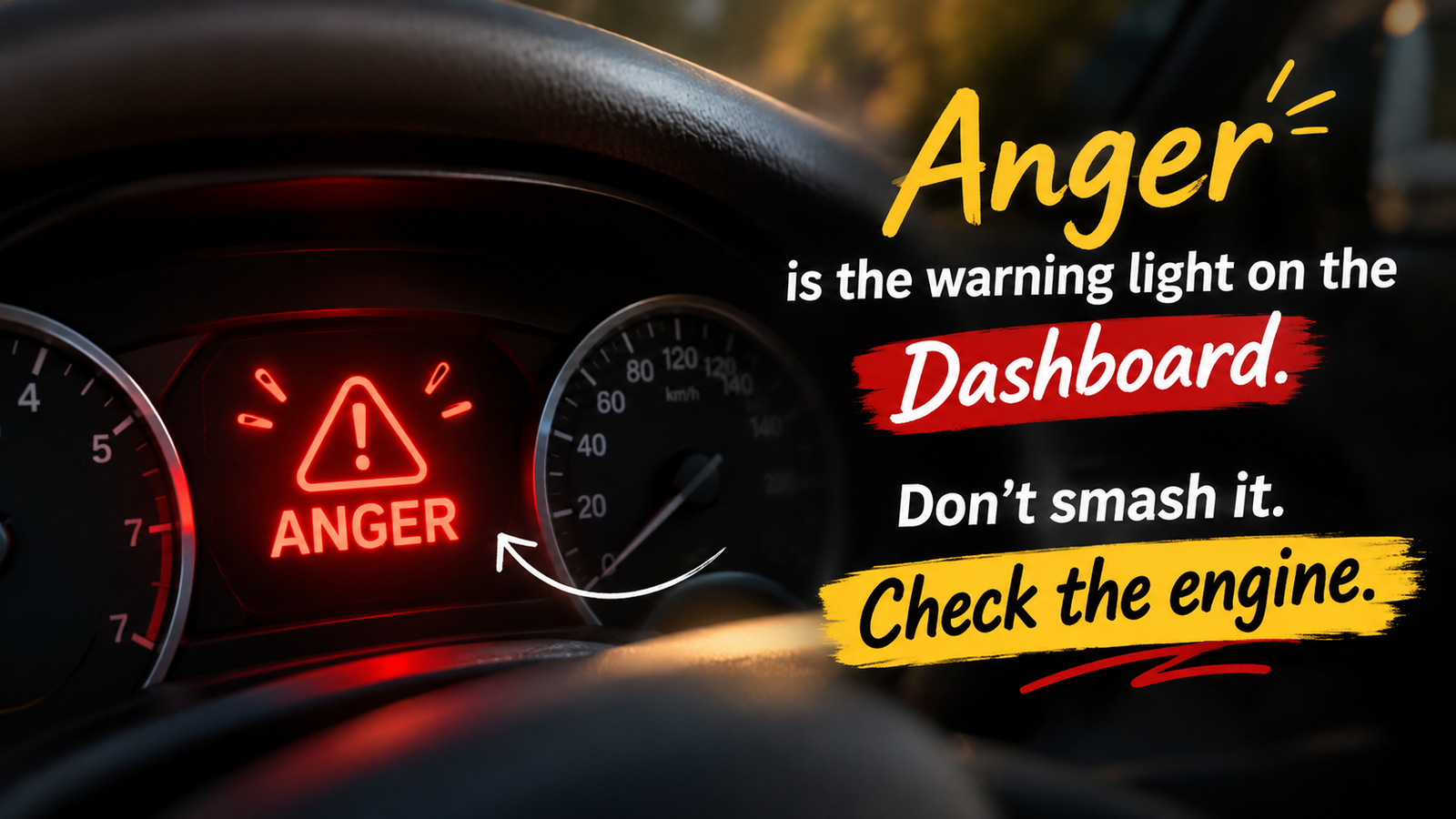
Anger is the warning light on the dashboard. Don’t smash it. Check the engine.
In this post
Short on time? Remember these 3 things
- Anger is a signal, not a sin. It tells you a boundary was crossed, a need isn’t met, or you’re hurt underneath.
- Before reacting, ask 3 questions: What triggered me? What is this anger protecting? What do I actually want to happen?
- Cool the body first, then speak. Feel the anger fully, but act on it slowly.
It’s 11:40 at night. Your manager has just sent a message on the team group: “This is not acceptable. Who approved this?” Your name is all over that project. Your heart is pounding, your face is hot, and your thumbs are already typing a reply that starts with “With all due respect…” and gets less respectful with every line. Your thumb is hovering over send.
We’ve all been there. With a boss, a partner, a parent, a sibling, a driver who cut us off. And we usually end up in one of two places: we explode and regret it, or we swallow it and carry it for days.
Both happen for the same reason. Nobody taught us what anger actually is. We were only told “gussa mat karo”. But you can’t stop a feeling by banning it. You can only understand it, and then decide what to do with it. That’s what this post is about.
Anger is not the enemy, it’s a messenger
Think of the warning light on your car’s dashboard. When it starts blinking, a smart driver doesn’t smash the light with a hammer. And he doesn’t cover it with tape and keep driving either. He pulls over and checks what’s wrong with the engine.
Anger is that warning light. It is your mind saying, “Something here needs attention.” Maybe someone crossed a line. Maybe you feel disrespected. Maybe you’re exhausted and running on empty. The anger itself is not good or bad. It’s information.
The problem starts when we skip the reading part and jump straight to the reacting part. Shouting, slamming doors, sending that message, going silent for three days. Anger is never the mistake. Acting on it without understanding it usually is.
Myth
Good, calm people don’t get angry.
Truth
Calm people get angry too. They’ve just learnt to read it before they react to it.
What your anger is usually trying to tell you
In my experience of working with professionals, couples and parents, anger almost always carries one of these five messages. Learn to recognise them, and half the battle is won.
1. “A boundary was crossed”
Your colleague takes credit for your idea. A relative comments on your weight at a wedding. Your boss calls you on a Sunday for something that could wait. Anger here is protecting your space, your time or your dignity. The message: “This is not okay with me.”
2. “A need isn’t being met”
You snap at your partner for not helping with the kids. Underneath, the need is: “I need support. I’m doing this alone.” The anger is loud, but the need is quiet. If you only express the anger, the other person hears an attack. If you express the need, they hear a request.
3. “Something feels unfair”
Your sibling gets all the praise while you do all the work for your parents. A teammate gets promoted for half your effort. Anger often shows up when our sense of fairness is hurt. The message: “I want to be treated justly.”
4. “I’m actually hurt or scared”
Anger is often the bodyguard of softer feelings. Under the anger at your teenager for coming home late is fear: what if something happened? Under the anger at your partner for checking their phone during dinner is hurt: do I even matter? Think of anger as the tip of an iceberg. The bigger feelings sit underneath.
5. “I’m running on empty”
Sometimes anger has nothing to do with the person in front of you. You’re hungry, sleep-deprived, overworked or stressed about money. Your fuse is short because your tank is empty. The message here is simple: “Take care of me.” Before any important conversation, check: Am I hungry? Tired? Overloaded?
“Don’t ask how to get rid of your anger. Ask what your anger is trying to protect.”
3 questions to ask before you send that message
This is the heart of the whole post. The next time you feel anger rising, before you speak, type or act, ask yourself these three questions. Even 60 seconds of honest answers will change what you do next.
What exactly triggered me?
Be specific. Not “he’s so rude”, but “he interrupted me twice in front of the client.” Not “she never cares”, but “she didn’t call when she said she would.” A specific trigger is something you can talk about. A general accusation only starts a fight.
What is this anger protecting?
Go one level deeper. Is it my respect? My time? My need for support? Am I hurt? Scared? Exhausted? Use the five messages above. Once you find the real feeling underneath, the anger usually drops by half.
What do I actually want to happen next?
Do you want to win the argument, or solve the problem? Do you want them to feel bad, or behave differently next time? Choose the response that gets you the outcome, not just the relief of venting. Often the answer is: “Not now. Tomorrow, calmly.”
Cool the body before you use the mind
When anger hits, your body goes into fight mode. Heart rate shoots up, muscles tense, and the thinking part of your brain takes a back seat. That’s why you can’t “think your way out” of anger in the first few minutes. You have to calm the body first.
Here’s what works:
Breathe slow and long. Breathe in for four counts, out for six. The longer out-breath tells your body it’s safe.
Move. Walk out of the room, take the stairs, go around the block. Anger is energy. Give it somewhere harmless to go.
Cold water. Splash your face or drink a full glass slowly. It’s simple and surprisingly effective.
Delay the reply. “Let me get back to you on this in an hour” is one of the most powerful sentences you will ever learn. Nothing important is ruined by a one-hour delay. Many relationships are ruined by a one-minute reply.

What reading your anger sounds like
Once you know what your anger is saying, you can say it out loud, calmly. The formula is simple: the specific trigger + the real feeling + what you need. Here’s how it sounds in real life.
With your boss, after being blamed in public
Don’t reply in the group at midnight. Wait, cool down, and speak one-on-one the next morning.
“Sir, can I take five minutes? Last night’s message in the group about the project felt quite harsh, and I want to make sure we fix the actual issue. Here’s what happened, and here’s what I’ve already done to correct it. In future, if something’s wrong, could you flag it to me directly first?”
With your partner, when you feel unsupported
Swap the accusation (“You never help!”) for the need underneath.
“I’m really frustrated right now, and I don’t want to say it the wrong way. When I handle dinner, homework and bedtime alone, I feel like I’m doing this on my own. I need us to split the evenings. Can we sit down this weekend and figure it out?”
For couples
Couple Communication Mastery
Learn how to fight the problem, not each other. Practical tools for Indian couples to handle anger, arguments and repair, together.
See the courseWith a relative who keeps commenting
Clear, short and respectful. No sarcasm, no lecture.
“Bua, I know you mean well, but comments about my weight in front of everyone really upset me. I’d appreciate it if we keep that topic out of family gatherings. Chalo, tell me about your trip!”
With yourself, when you’ve already exploded
It will happen sometimes. What matters is the repair. Go back, own it, and name what was underneath.
“I’m sorry I shouted earlier. That wasn’t okay. I was actually really stressed about work and I took it out on you. You didn’t deserve that. Can we talk about what happened, calmly?”
Anger and parenting
Nothing tests your anger like a child who has spilled the milk for the third time, refuses homework, or throws a tantrum in a mall. And most of us end up doing exactly what our parents did: shouting.
Read the message here too. Usually it’s “I’m exhausted”, “I feel out of control” or “I’m scared they’ll turn out badly”. Your child doesn’t need a parent who never gets angry. They need a parent who shows them what to do with anger. When you say, “I’m feeling very angry right now, so I’m going to take a few breaths before I talk,” you’re teaching the most important emotional lesson of their life, without a single lecture.
For parents
Parenting Without Shouting
Simple tools to stay calm when your kids push every button, and raise children who know how to handle their own big feelings.
See the courseWhen anger becomes a problem
Everyone gets angry. But it’s worth looking at more seriously if you notice that you’re angry almost every day, people around you seem scared of your reactions, you break things or say things you deeply regret, your anger is hurting your relationships or job, or you’re using alcohol or other escapes to calm down.
If that sounds familiar, please don’t carry it alone. Talking to a counsellor or therapist is not weakness. It’s one of the strongest things you can do for yourself and the people you love. And if anyone ever feels unsafe because of anger, at home or anywhere else, getting help immediately is the priority.
Keep a 7-day anger log
Every time you feel angry this week, write one line in your phone notes: “Trigger: ___. Underneath I felt: ___. I needed: ___.” Don’t judge, just notice. By day seven, you’ll see patterns: the same people, the same times of day, the same hidden needs. That’s your anger’s message, finally written down.
The bottom line
Your anger is not your enemy. It’s a loyal, loud messenger trying to protect something that matters to you. Don’t shoot the messenger, and don’t let it run your life either.
Pause. Cool the body. Ask the three questions. Then speak the real message calmly. That’s not suppressing anger. That’s mastering it.
Topics
Was this post useful?
Thank you! Share it with one person who needs to hear this today.

Written by
Jai V. Pareek
India’s Practical Transformation Coach · Author of Shut Up and Level Up
I learned most life skills the hard way, so you don’t have to. Since 2017 I have trained students, professionals and couples in soft skills and emotional intelligence, in simple language and with real-life examples.
Reading is step one
Ready to turn anger into clarity?
My short courses on emotional intelligence, communication and relationships give you daily tools to handle anger before it handles you. If anger is hurting your work, marriage or parenting right now, book a 1:1 and we’ll work on it together, privately.

Quick answers
Questions people ask
Is it bad to feel angry?
No. Anger is a normal, healthy emotion. It tells you something matters. What can be harmful is how we act on it: shouting, insulting, hitting, or holding it in until it explodes.
Isn’t suppressing anger the same as controlling it?
No. Suppressing means pretending it isn’t there, and it usually leaks out later as sarcasm, silence or a bigger outburst. Controlling means noticing it, understanding it, and choosing a calm way to express it.
Why do I get angriest at the people I love most?
Because we feel safest with them, and because their actions matter more to us. We also bring our office stress home. Noticing this pattern is the first step to protecting your closest relationships from it.
How long should I wait before responding when I’m angry?
At least long enough for your body to calm down, usually 20 minutes to an hour. For big issues, sleeping on it is often the best decision you can make. Very few messages truly need an instant reply.
When should I get professional help for anger?
If anger shows up most days, frightens people around you, leads to breaking things or hurting anyone, or is damaging your relationships or work, please speak to a counsellor or therapist. Asking for help is a strong, responsible step.
Keep reading
You might also like

Emotional intelligence for men · 10 min read
Emotionally strong, not emotionally silent
Why silence isn’t strength, and how men can build real emotional intelligence.
Read the post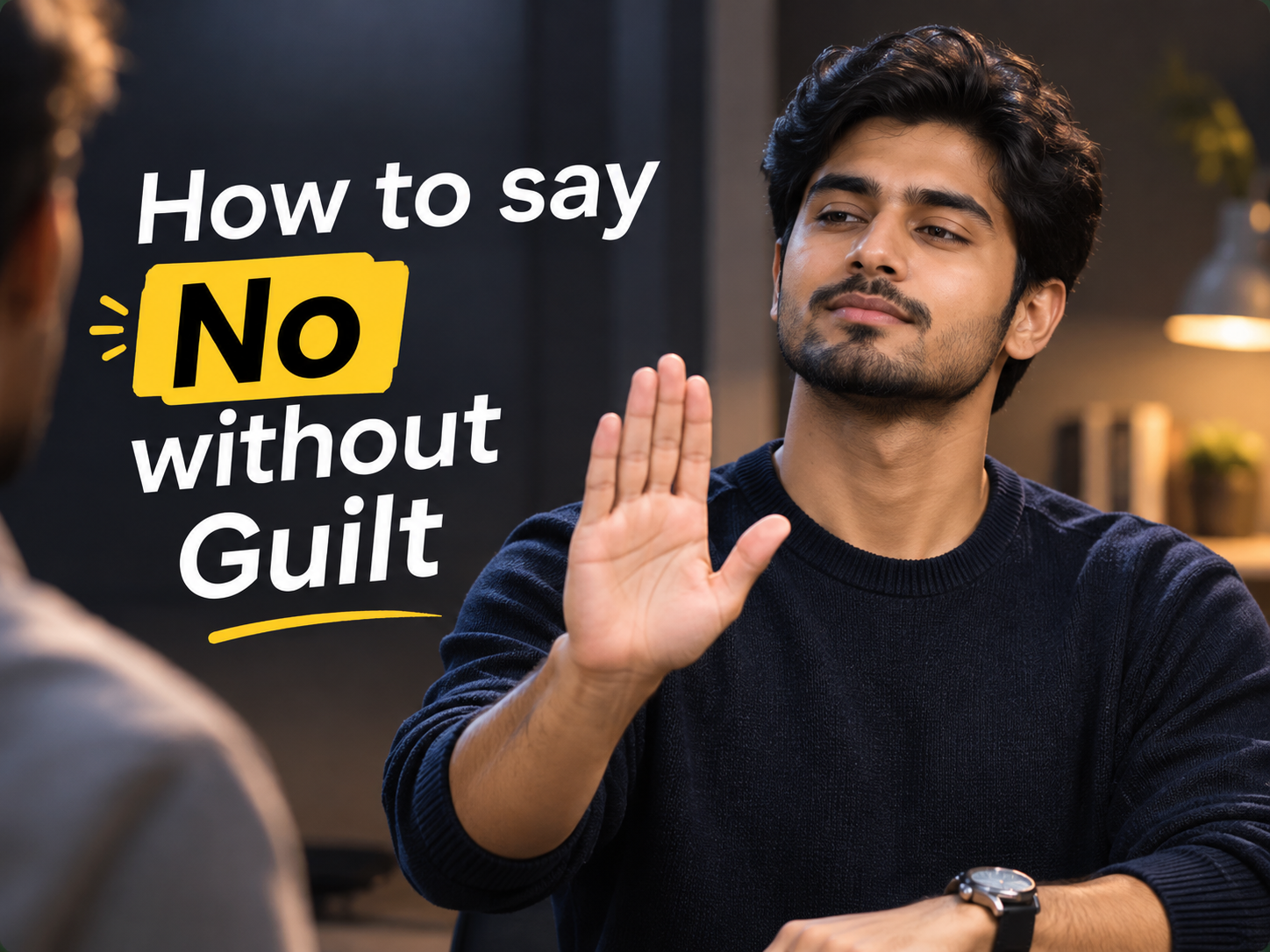
Soft skills · 7 min read
How to say no without feeling guilty
A simple 3-line script for your boss, relatives and friends.
Read the post
Indian men · 10 min read
What nobody teaches men about rejection
Rejection is information, not a verdict. Here’s how to bounce back.
Read the postOne useful life skill. Every Sunday.
Short, practical, no spam. Unsubscribe anytime.
Sign-ups open soon.